

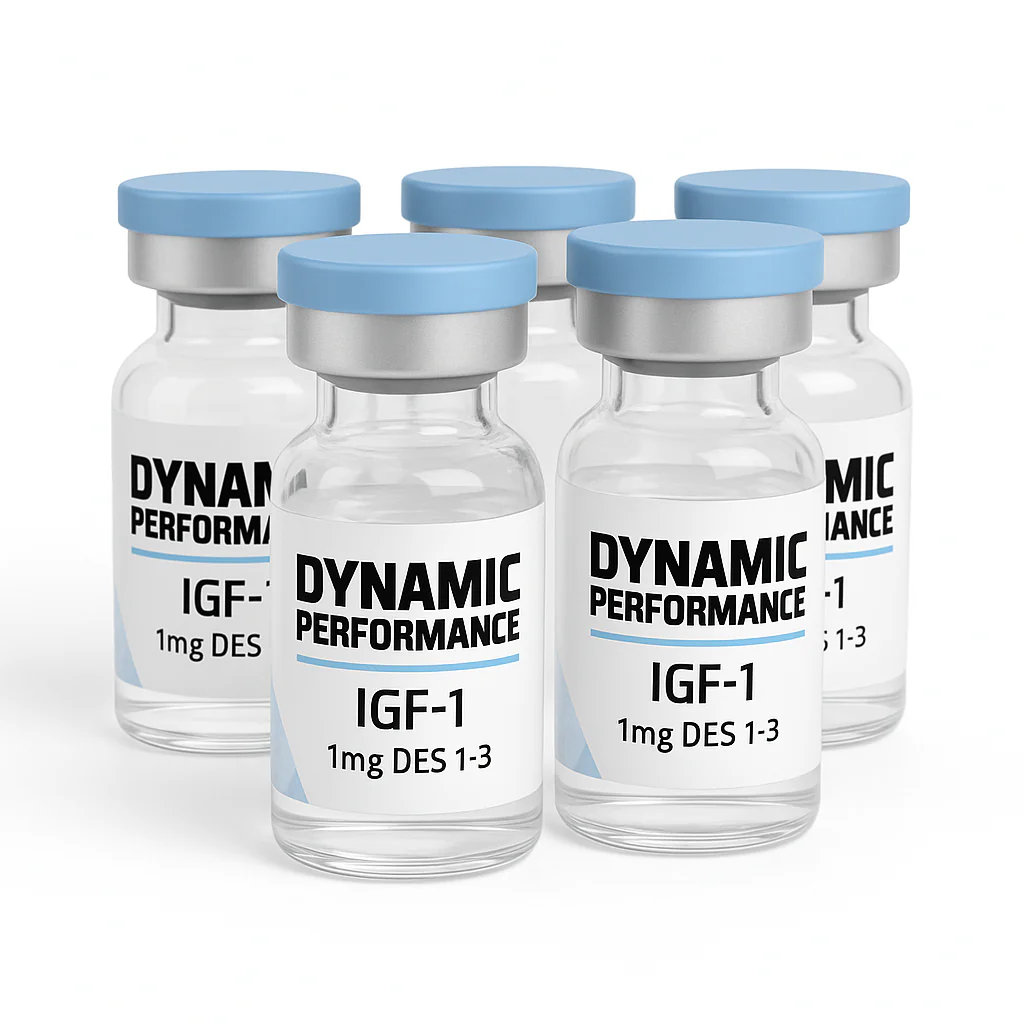
Hormones and protein growth factors play a key role in the formation and maintenance of muscle mass. One of the most interesting and effective compounds influencing muscle development is DES(1-3) IGF-1. This peptide is considered an active form of insulin-like growth factor, possessing a pronounced anabolic effect and the ability to accelerate recovery processes after physical exertion. Its action attracts the attention of athletes, researchers, and specialists in the field of human physiology.
What DES(1-3) IGF-1 Is
DES(1-3) IGF-1 is a shortened version of insulin-like growth factor (IGF-1) in which three amino acids are missing from the N-terminus of the molecule. This modification makes the peptide significantly more active and stable compared to standard IGF-1. As a result, it binds more quickly to cellular receptors and stimulates muscle fiber growth more effectively.
The main advantage of DES(1-3) IGF-1 lies in its localized action. It does not simply circulate in the bloodstream, but works directly at the site of administration or tissue damage. This is especially important for post-workout recovery, when microdamage to muscle fibers requires rapid regeneration.
Mechanism of Action of DES(1-3) IGF-1
The peptide works by activating IGF-1 receptors in muscle tissue cells. After binding to these receptors, a cascade of reactions is triggered that promotes the growth of new cells and strengthens existing ones. At the same time, protein synthesis increases while protein breakdown decreases, creating ideal conditions for muscle volume growth.
The main processes stimulated by DES(1-3) IGF-1 include:
- enhanced division of satellite cells (myosatellites) responsible for muscle fiber regeneration;
- increased formation of protein structures within cells;
- accelerated delivery of nutrients to damaged areas;
- stimulation of angiogenesis — the formation of new blood vessels.
Due to these effects, muscles recover faster after training, become denser, and gain strength.
The Importance of DES(1-3) IGF-1 for Muscle Growth
Muscle mass growth depends not only on training, but also on the body’s ability to recover. When recovery is insufficient, muscles do not have time to strengthen, and progress slows. DES(1-3) IGF-1 helps address this issue by activating natural anabolic mechanisms.
Key benefits of the peptide for muscle development include:
- accelerated recovery after intense training;
- increased density and strength of muscle fibers;
- support for muscle growth even with low testosterone levels;
- reduced recovery time after injuries and surgeries;
- minimization of catabolism (tissue breakdown).
All of these properties make DES(1-3) IGF-1 a powerful tool for maintaining physical condition and preventing muscle overfatigue.
The Role of DES(1-3) IGF-1 in Tissue Regeneration
Muscle recovery after physical exertion or injury is a complex process that requires the involvement of many factors. DES(1-3) IGF-1 accelerates this process by enhancing cellular regeneration and improving tissue metabolism. It promotes the formation of new fibers and increases the muscles’ ability to adapt to stress.
In addition, the peptide affects the recovery of connective tissue and tendons. This helps prevent inflammation, strains, and other injuries common among athletes and people with high physical activity.
Main recovery effects include:
- faster healing of microdamage;
- reduction of post-exercise inflammation;
- improved tissue elasticity;
- increased muscle resistance to stress.
After the use of DES(1-3) IGF-1, a quicker return to regular training is often observed without the feeling of fatigue or muscle soreness.
Factors That Enhance the Effect of DES(1-3) IGF-1
Although the peptide has a strong effect, its effectiveness depends on several factors. To achieve maximum results, its use should be combined with a proper lifestyle.
Key conditions for optimal effectiveness include:
- adequate protein intake in the diet;
- regular but moderate training;
- quality sleep (at least 7–8 hours per night);
- maintenance of optimal vitamin and mineral levels;
- avoidance of chronic stress and overtraining.
Without these conditions, even the most potent peptide will not ensure full muscle growth. The body must be in a state capable of responding to signals of growth and regeneration.
DES(1-3) IGF-1 is one of the most promising peptides used to stimulate muscle growth and recovery. Its effectiveness is supported by numerous studies: it accelerates tissue regeneration, enhances protein synthesis, and promotes the formation of new muscle fibers. Thanks to this peptide, the body adapts more quickly to physical stress, endurance increases, and overall physical performance improves.